
Deepfake Influencers & Synthetic Testimonials: The Next Review Scam Wave
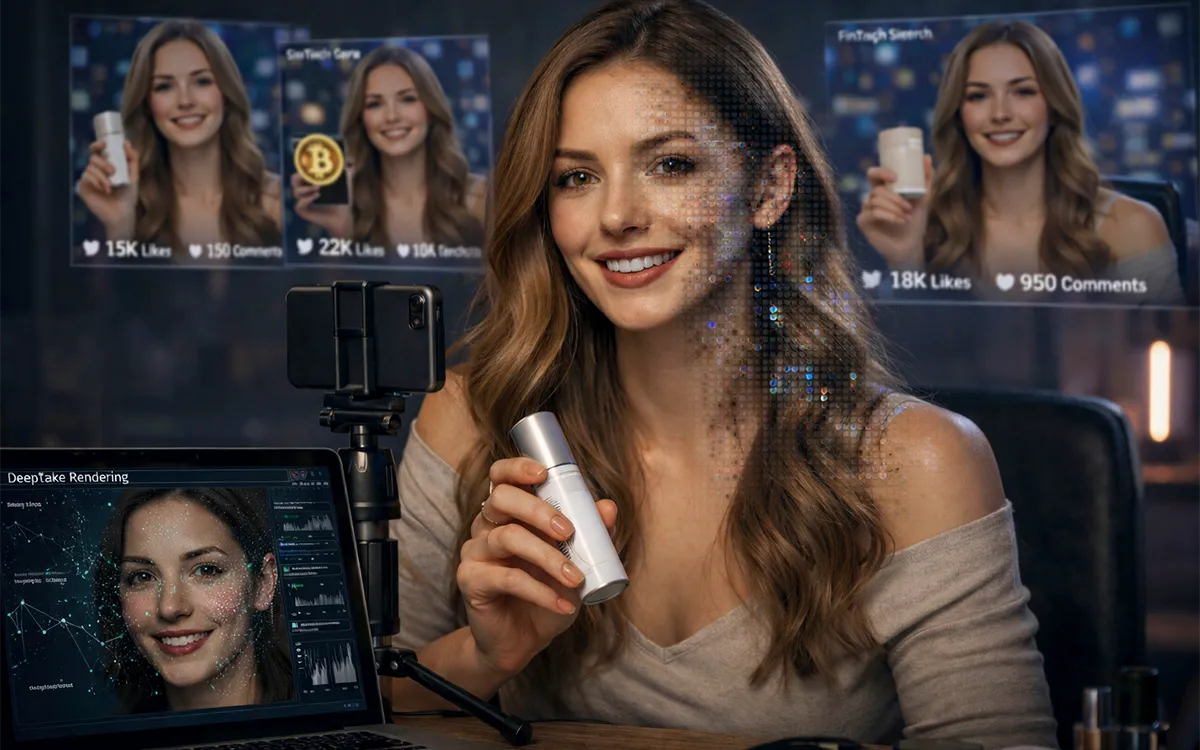
The AI-generated media is not experimental anymore. It is now quick, convenient, and even more persuasive. Video generators can produce realistic faces. The use of voice cloning devices can replicate tone and speech patterns in a few minutes. The content in written form can be mass-produced without the human writer even striking a keyboard.
Simultaneously, the culture of influencers has transformed the way individuals make product judgments. Several consumers have more confidence in short-form videos and personal recommendations than in traditional advertising. One passionate testimonial, in many cases, resonates more than a banner advertisement or description of a product.
It is this change in trust that scammers have been observing. Credibility is currently being produced using Deepfake technology. Fraudsters are creating artificial trust instead of developing one based on reality. The outcome is a new breed of review fraud through AI-based influencers and fake testimonials.
What Are Deepfake Influencers and Synthetic Testimonials?
Deepfake influencers:Â Deepfake engagements are computer-generated artificial characters that are meant to look and sound authentic and advertise goods or services. Synthetic testimonials are artificial video, audio, or written reviews that simulate authentic customer reviews.
Deepfake influencers do not consist of photo editing or filters. They are all fake characters that are generated through generative AI. These computer-generated characters are able to record videos, use a natural voice, and communicate with viewers. In most instances, what is behind the account is no actual human being.
Synthetic testimonials:
This is further advanced in synthetic testimonials. Scammers do not have to pay their actors or engage real users to perform their reviews by creating believable video or audio endorsements with the help of AI tools. A bogus customer is present on the screen and talks with a lot of confidence about a product and provides a made-up success story.
It is now easy to create fake endorsements using AI tools. Text-to-video faces are made to look realistic. Speech patterns are cloned in voice cloning software. The AI writing models create realistic customer experiences. Put together, they produce what appears to be genuine social evidence, albeit completely false.
According to DeepStrike, deepfake files will grow by 500K in 2023 and 8M in 2025, with fraud attempts up 3,000 percent across the globe and 1,740 percent in North America, and human identification of quality fakes is only 24.5 percent.
Large-scale fraud and identity theft made possible in synthetic media is now the core risk, with voice cloning being the most popular low-cost, high-impact attack vector.
Why Deepfake Review Scams Are Increasing
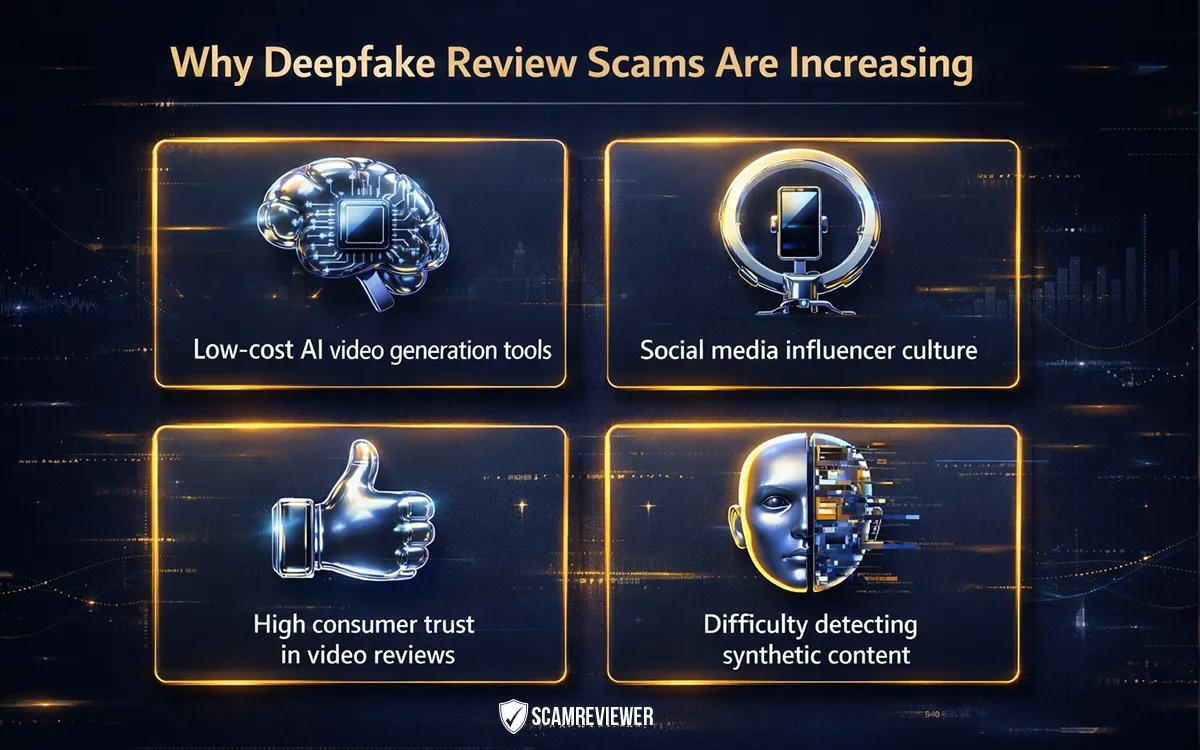
Several forces are driving the growth of deepfake review scams.
Low-cost AI video generation tools
The AI video systems have been made affordable and user-friendly. You can now purchase a subscription and a script to do what you used to do with some great technical skills. In a day, a number of dozens of testimonial videos can be created by fraudsters, which significantly reduces the entry threshold into the field of manipulation of reviews.
Social media influencer culture
Influencer marketing has normalized personal recommendations as a sales channel. Audiences are used to seeing individuals promote products in informal, relatable ways. This format makes it easier for fake influencers to blend in without raising suspicion.
High consumer trust in video reviews
Video is a more natural format than text. The use of facial expressions, tone of voice, and body language develops an emotional bond. Fraudsters take advantage of this psychological bias by using deepfake technology to create a natural human behavior.
Difficulty detecting synthetic content
Media generated by AI is getting better at an alarming rate. Minor visual crackouts and deepfakes are starting to be more difficult to detect. To a large audience, one can no longer tell the difference between real and fake content.These conditions create the perfect environment for deepfake marketing fraud to spread quietly.
How Deepfake Influencers Are Used in Scams
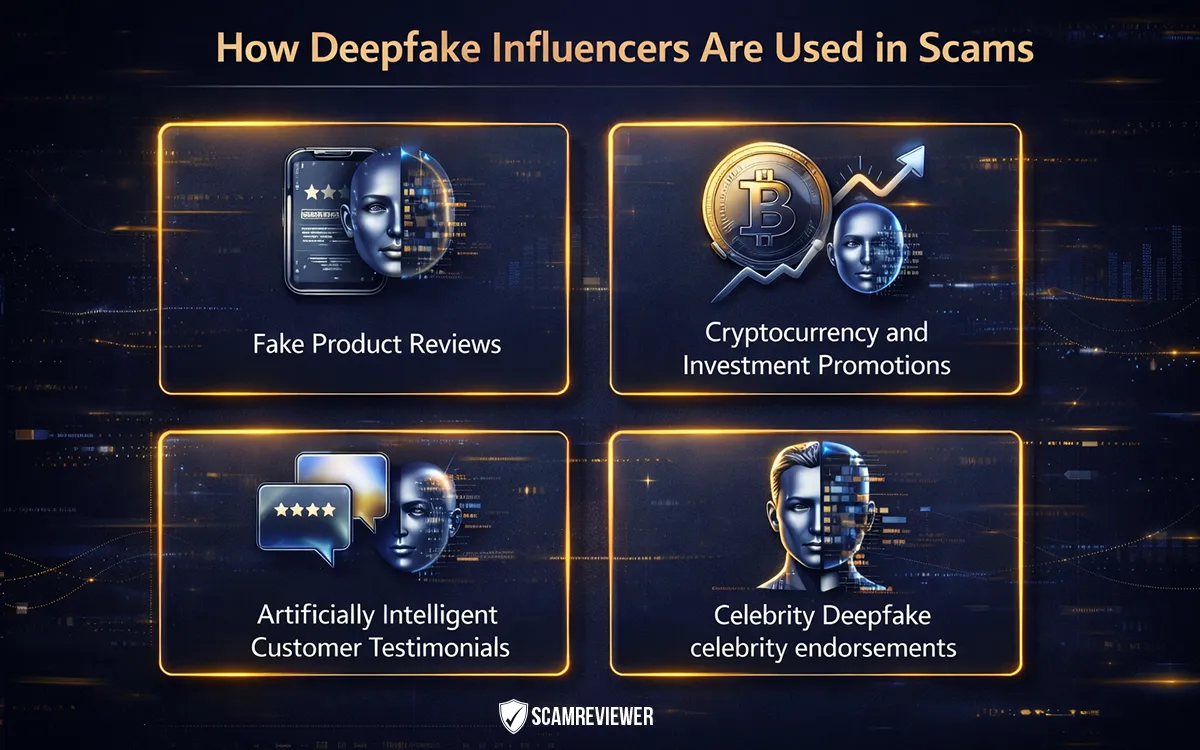
These scams that involve deepfake influencers are done in the following ways.
Fake Product Reviews
Fake websites today are also using AI-generated influencers to advertise dubious or even nonexistent products. The influencer can also sound wise, passionate, and likable. As a matter of fact, the individual does not exist.
Such false reviews feature faked demonstrations and descriptive information concerning the benefits of products. The presence of the influencer on camera leads to a sense of authenticity on the part of the viewer. The perception of the individual recommendation raises the risk of unplanned purchases.
Cryptocurrency and Investment Promotions
Influencers with deepfakes are becoming the preferred tool to market fraudulent trading systems or investment schemes with high returns. An efficient video will depict a self-assured persona on how a platform brought lots of profit.
Some of the scammers even use AI-generated faces in conjunction with forged dashboards and trading screenshots. The whole story is developed to create urgency and trust. After money has been deposited, the victims usually find the site to be fake.
Artificially Intelligent Customer Testimonials
Most fraud sites will now have video testimonials of alleged clients. These people are talking about life-transforming outcomes or quick monetary riches. The narratives are described sufficiently to be personal.
Nonetheless, these testimonials are very likely to be created with the help of AI video generators and scripted storylines. No real customer exists. The testimonials are simply a piece of artificial credibility.
Celebrity Deepfake celebrity endorsements
The most frightening aspect is the use of deepfake endorsements by celebrities. Fraudsters use video records to impress that a well-known personality is endorsing a product or investment.
These videos can be shared on social media advertisements or communication channels. A familiar face is a source of instant credibility. To most viewers, exposure to a well-known personality will lessen the level of skepticism despite the fact that the endorsement may be a fake one.
The Role of Synthetic Testimonials in Fake Reviews
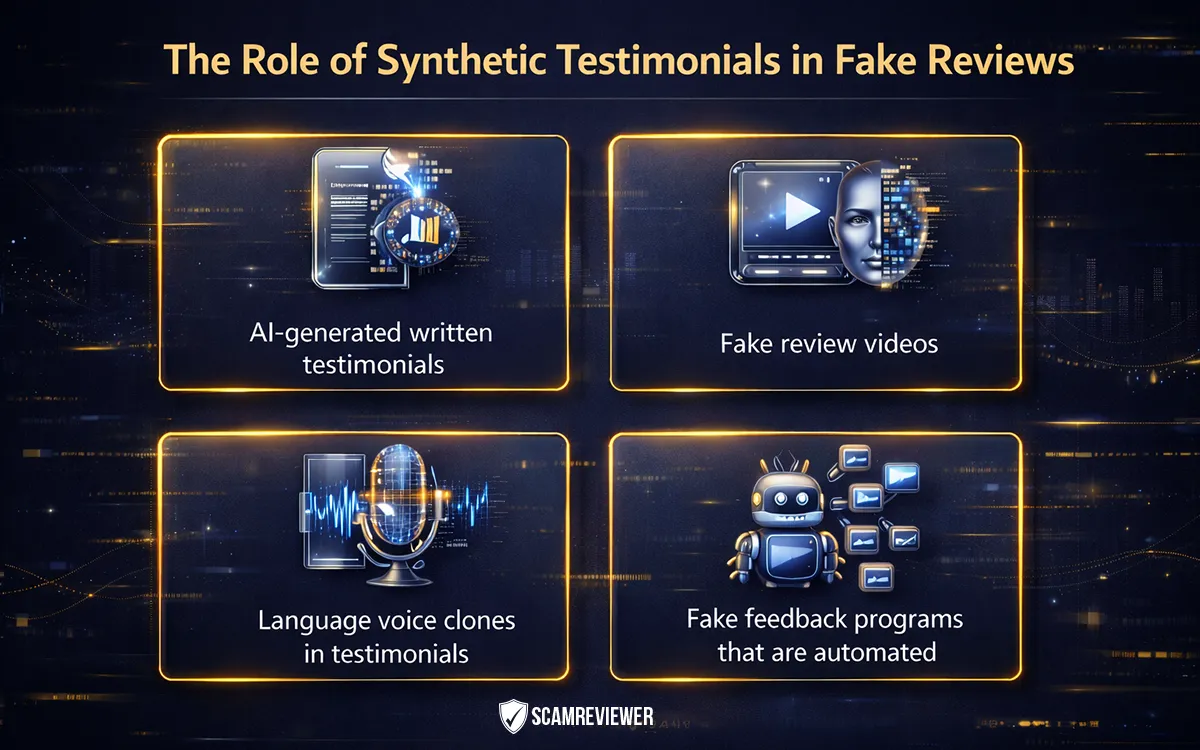
Synthetic testimonials allow scammers to scale fake trust signals in ways that were previously impossible.
AI-generated written testimonials
Hundreds of positive reviews of products can be created by AI in a few minutes. These testimonials tend to have certain details in order to replicate real customer experiences. They are different in tone and wording and, therefore, much harder to detect.
Fake review videos
Video testimonials are now an effective conversion tool. The AI faces that scammers create are used to provide persuasive praise of products. The videos are customizable without having to employ actors to suit different demographics, languages, or markets.
Language voice clones in testimonials
The voice cloning technology enables fraudsters to produce realistic audio recommendations. A product can be described using the cloned voice or a voice simulating that of a happy customer. Combined with the stock footage or AI avatars, the outcome seems real.
Fake feedback programs that are automated
The AI systems are able to spread artificial reviews to various platforms at the same time. Coordinated positive reviews can be done on fake influencer accounts, fake review websites, and social media comments. This gives them a false sense of popularity and credibility.
Manpower is no longer a constraint with scammers due to automation. Now, it is possible to generate trust signals at scale.
Red Flags That Reveal Deepfake Review Scams
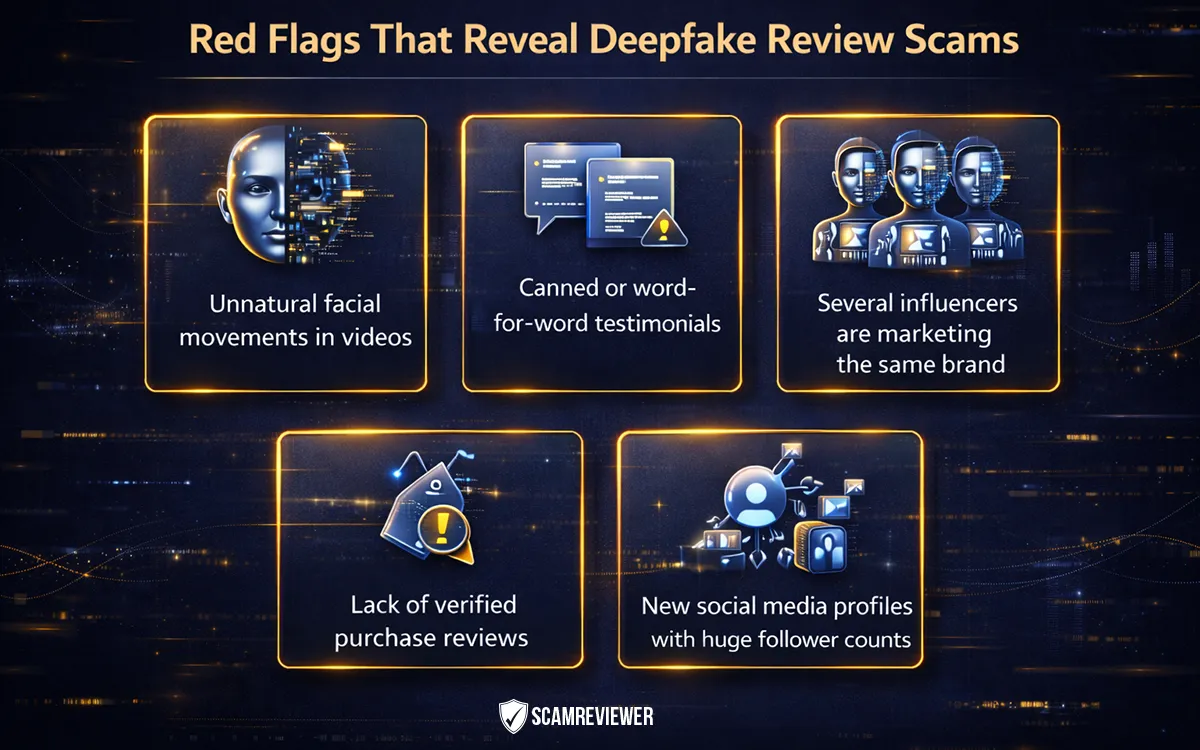
Certain warning signs may indicate synthetic influencer activity or deepfake review scams.
Unnatural facial movements in videos
Minor glitches that appear at the edges of the eyes, lips, or the edges of the face can be indicative of manipulation.
The presence of lighting anomalies or even a minor delay in lip synching can also allude to AI-generated content creation.
Canned or word-for-word testimonials
Praise that is over-polished and lacks details that can be verified is a general warning. Testimonials that are too emotionally based and not practical in nature usually refer to the scripted content.
Several influencers are marketing the same brand
In cases where multiple accounts are running with parallel advertising of a product with similar messages, they might be coordinated. The legitimate influencer campaigns tend to be more variable and transparent.
Lack of verified purchase reviews
On e-commerce platforms, the absence of verified buyer badges can signal review manipulation. A large number of positive comments without proof of purchase should raise caution.
New social media profiles with huge follower counts
Accounts that appear recently created but have unusually high follower numbers may rely on artificial growth. Limited posting history combined with high engagement can indicate synthetic amplification.
How Consumers Can Detect Deepfake Influencers
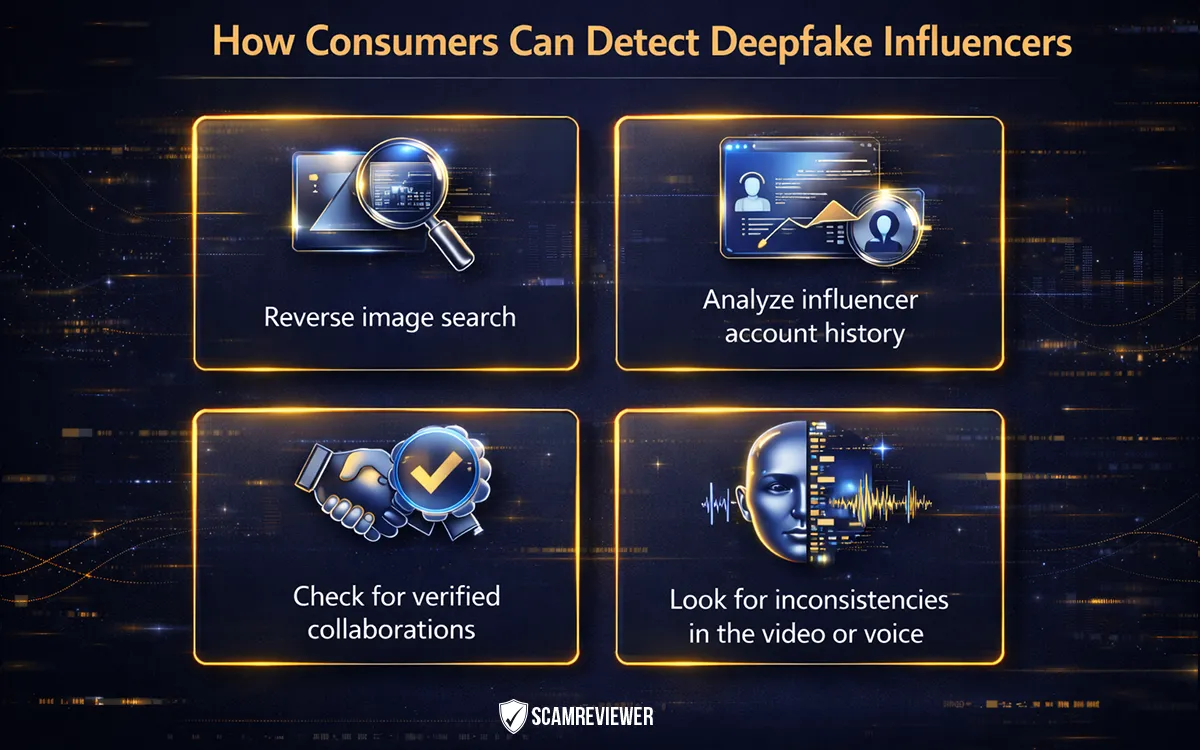
Verification requires patience and small investigative steps.
Reverse image search
Images from influencer profiles can be checked using reverse image tools. If profile photos appear elsewhere under different names, impersonation may be involved.
Analyze influencer account history
Genuine influencers typically have a consistent posting timeline and varied content. Accounts that suddenly appear with polished promotional material but little personal history warrant caution.
Check for verified collaborations
Established influencers often tag brands, agencies, or verified partners. Absence of clear collaboration disclosures may indicate fabricated endorsements.
Look for inconsistencies in the video or voice
Variations in accent, unnatural pauses, and unmatching facial expressions can be indicative of AI manipulation.It is essential to carefully observe the suspicious promotions and refrain from clicking on unknown links and transferring money unless the authenticity of the promotions is confirmed.
The Future of Review Scams in the AI Era
Synthetic influencers will probably be on the rise. This is because it will be increasingly difficult to differentiate between AI avatars and human influencers as they become more realistic. The scope of AI-generated trust signals, like testaments and engagement rates, will only increase.
Scammers will be quick to develop counter-measures for detection methods. This will create an endless cycle. The result may not be technology-dependent. Verification practices, digital literacy, and platform policies will be crucial.
Review authenticity verification will likely become a standard expectation rather than an optional safeguard. In order to check any kind of business review, visit us at Scam Reviewer.
When Trust Becomes Synthetic
Deepfake technology is reshaping the landscape of review fraud. What once required staged photos or paid actors can now be automated with AI tools.
Trust in influencer marketing is increasingly vulnerable. When faces, voices, and stories can be generated on demand, visual proof no longer guarantees authenticity.
Critical thinking and verification are becoming essential skills. The ability to question digital endorsements may determine whether synthetic persuasion succeeds or fails.
The next wave of review scams is not built on stolen identities alone. It is built on manufactured realities. To tally the authenticity of any business, connect with us at Scam Reviewer.
FAQs
How can you detect deepfake influencer scams?
Look for unnatural facial movements, scripted language, inconsistent account history, and lack of verified collaborations. Reverse image searches can also help identify impersonation.
Is the use of deepfake celebrity endorsements legal?
The unauthorized use of the celebrity’s image could be considered illegal in many jurisdictions. However, there is no immediate action against the offenders.
Why are AI-generated reviews becoming more common?
The use of AI is becoming more common because the tools are affordable. With the aid of AI tools, scammers are able to generate more content with minimal costs.
What would be the best course of action if you find deepfake scam promotions?
The best course of action would be to avoid the suspicious links and investment offers.