
Social Media Scams And How To Avoid Them
Social media has become a major platform for scammers. With billions of users sharing personal details daily, social media scams now account for a significant portion of online fraud cases worldwide.
Fake social media accounts, phishing links, impersonation messages, and investment scams on social media are growing because platforms encourage quick interactions and trust-based communication. Many victims don’t question messages until it’s too late, especially when scams appear to come from friends, influencers, or customer support.
In this guide, we break down what social media scams are, why users are increasingly targeted, and how to avoid scams on social media platforms. You’ll also learn how to spot red flags early and protect yourself from common social media scams.
What Are Social Media Scams?
Social media scams often catch people off guard because they happen inside apps we trust. A message may seem friendly, an ad may look exciting, or a comment may feel genuine, but the intention behind it is to take money or personal information.
These scams usually begin with fake profiles or messages that feel ordinary. Scammers act caring or helpful to lower a person’s guard before slowly leading them into a trap. Over time or sometimes within minutes, they create urgency by saying something must be done immediately.
This combination of trust and pressure is what makes a scam on social media so effective. Users are told they’ve won something, their account is at risk, or an investment opportunity will disappear soon.
By the time the truth is discovered, the money or data is often already gone. Common examples include phishing on social media, romance scams on social media, fake giveaway scams, and investment scams on social media.
Why Social Media is a prime target
The number of users makes social media a prime target of scammers. It is just that scammers can simply access a lot of people with minimal expense, with billions online every day.
- Fitting In with Day-to-Day Conversation: Social media frauds are usually merged into regular conversations, and therefore, it is difficult to identify them.
- Perpetrators are easily accessible and always available: Individuals are never out of business on these sites, which offer inexhaustible potential victims.
- Quickly Installing Fraudulent Accounts: Fraudsters can easily install fraudulent accounts using stolen images and biographies, and they appear credible.
- Rapid Communication: The speed of social media stimulates users to respond promptly, most of the time without thinking.
- Taking advantage of trust: Fraudsters exploit deceptive giveaways and spoof brands by taking advantage of the trust that users place in their friends and influencers.
- Manipulation of Emotions: Most fraud schemes use emotional appeals to pressure users to respond without reasoning.
- Quick Sharing: Thousands of people can fall prey to a scam within minutes as it is shared.
You are able to use these to guard yourself against social media fraud better by understanding these tricks.
Common Social Media Scams
Social media scams come in many forms, but most follow familiar patterns. Understanding the most common social media scams makes it easier to recognize scam messages early, avoid fake social media accounts, and protect yourself from online scams on social media before real damage occurs.
| Scam Type | How It Works | Why People Fall for It |
| Fake Giveaway & Influencer Scams | Scammers pretend to be influencers or brands and claim you’ve won a prize. Victims are asked to click a link or pay a “small fee.” | The offer feels exciting and time-limited, and the account looks familiar or popular. |
| Investment & Crypto Scams | Fake accounts promote guaranteed profits through crypto, forex, or private investment groups. Once money is sent, it’s gone. | Promises of fast returns and fear of missing out drive quick decisions. |
| Romance & Relationship Scams | Scammers build emotional relationships over time, then ask for money due to emergencies or investment opportunities. | Emotional trust develops slowly, making requests feel genuine. |
| Impersonation & Support Scams | Scammers pose as customer support, companies, or even friends, claiming account issues or verification problems. | The message creates fear and urgency, pushing for quick action. |
| Job & Marketplace Scams | Fake job offers or product listings ask for upfront fees, deposits, or personal details. | People trust professional-looking posts and urgent job offers. |
| Deepfake & AI-Generated Scams | AI-generated images, voices, or videos impersonate real people to make scams look authentic. | Visual and voice realism lowers suspicion and builds false trust. |
These common social media scams often overlap and evolve. A fake giveaway can lead to phishing on social media, while a romance scam can turn into an investment scam.
How Social Media Scams Work
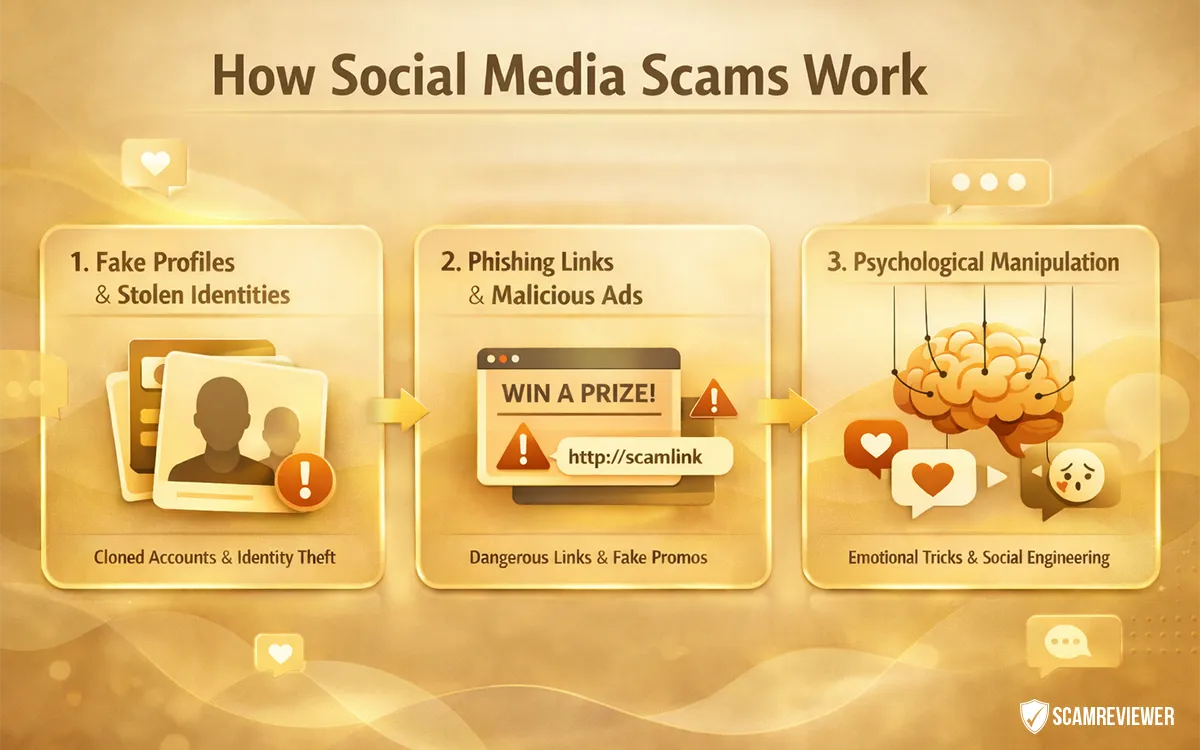 The social media frauds tend to have a specific pattern. The messages and platforms can vary, but the action of how social media scams are executed remains mostly the same. This knowledge will enable one to easily identify scams before it is too late.
Step 1: Fake Profiles and Stolen Identities
False social media accounts form the basis of most fraud on social media. To present themselves as genuine, scammers make use of stolen photos, duplicated bios, and falsified activity. Others even take the role of real people, influencers, or customer care departments.These profiles are meant to fit in and win trust fast. Users do not usually question them because they appear familiar or professional.
Step 2: Phishing Links and Malicious Ads
Once contact is made, scammers introduce phishing on social media. This may come in the form of:
- Links sent through direct messages
- Fake login pages
- Sponsored ads promoting giveaways or investments
Clicking these links can lead to stolen passwords, drained wallets, or malware installation. Many money scams on social media rely on these links to capture sensitive information instantly.
Step 3: Psychological Manipulation Tactics
This is where social engineering scams become powerful. Scammers use emotional pressure to control decisions, including:
- Urgency: “Your account will be suspended today”
- Fear: “Suspicious activity detected”
- Excitement: “You’ve won a prize”
- Trust: Pretending to be friends, partners, or support staff
Social media encourages quick reactions and constant engagement. Combined with trust-based interactions, this environment allows scam messages on social media to succeed before users realize something is wrong.
Understanding this step-by-step process is one of the most effective ways to avoid social media scams and protect yourself online.
How to Identify Social Media Scams
Social media scams rarely look like scams at first. Most start as normal messages-friendly, helpful, or even exciting. That’s what makes them easy to miss.
A good first step is to question anything you weren’t expecting. If you get a message about winning a prize, a sudden investment opportunity, or “support” reaching out when you didn’t ask for help, pause. Many money scams on social media begin exactly this way.
Then, be attentive to links and demands for payment. Fraudsters normally invite you to click a link, transfer crypto, purchase gift cards, and/or provide log-in information. These are a few of the most obvious warning indicators.
Lastly, briefly, examine the profile behind the message. The fake accounts on social media usually do not have much activity, duplicated pictures, or genuine communication. Several seconds of searching can bring you out of severe trouble.
How to Avoid Social Media Scams
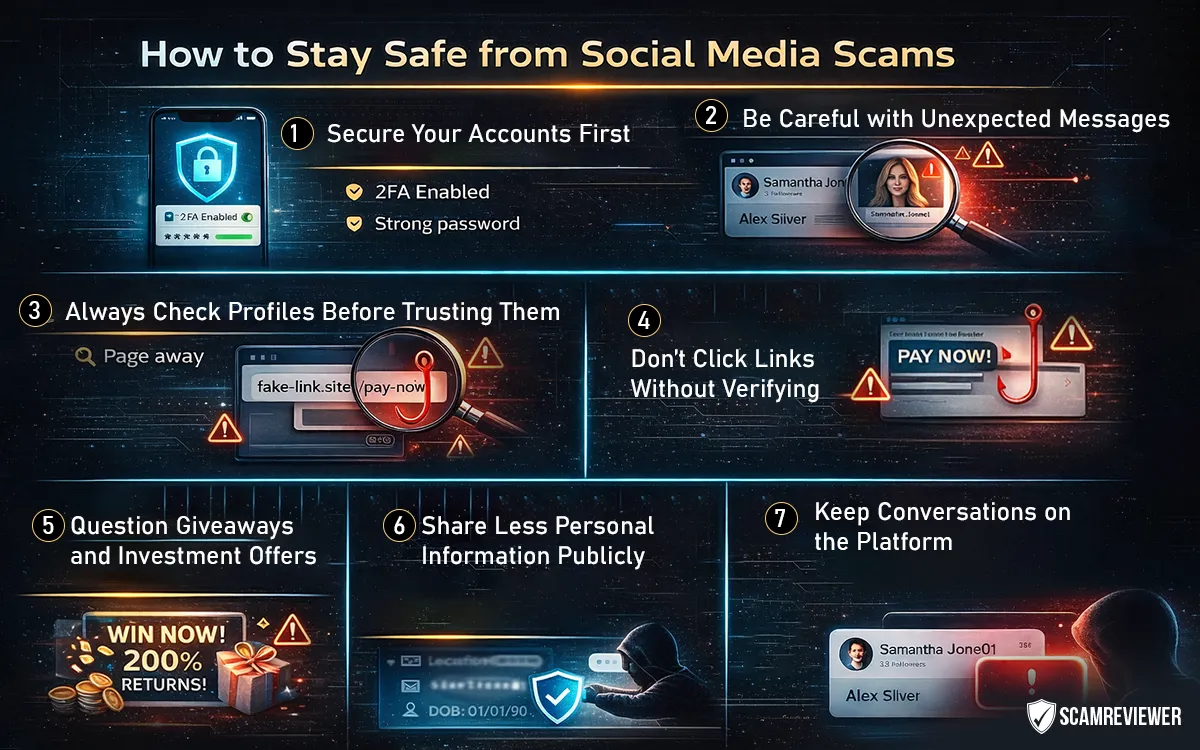 The point of avoiding social media scams does not require you to be suspicious of everyone, but rather to employ a few smart habits that would help keep your money, personal information, and accounts safe when you otherwise use social media.
- Secure Your Accounts First
Create very strong and individual passwords for all social media accounts and use two-factor authentication where possible. This makes it extremely difficult, even in the case that scammers are able to steal some of your logins, to hijack your account.
- Be Careful with Unexpected Messages
One should always be sensitive to messages that are not known or communicated by people who are trusted. Most of the social media scams begin as harmless interactions, which develop trust and then seek money, links, or information.
- Always Check Profiles Before Trusting Them
Glance at the profile that is sending the message. Fake social media profiles may have very few posts, copied images, or new profiles. A quick check can save you from impersonation scams.
- Don’t Click Links Without Verifying
Do not click on links that are sent through direct messages or comments unless you are sure of where they will take you. The phishing links on social media sites may appear genuine, but they will direct you to a fake login page where your information will be stolen.
- Question Giveaways and Investment Offers
A type of promotional offer or giveaways a company makes as part of a marketing plan. In case it is a promise in the offers of guaranteed profits, free prizes, or time-sensitive offers, then it is bound to be a scam. No real businesses or firms request payments, wallet attachments, or verification charges using social media messages.
- Share Less Personal Information Publicly
The more you give, the more chances you give to be attacked by fraudsters. Being able to maintain personal phone numbers, travel plans, and financial details confidentially makes it harder to believe scam messages. - Keep Conversations on the Platform
To avoid scammers, make an effort to change the discussion to a personal messaging platform. When one is on the platform, it is easier to detect red flags and report them.The success of most of the social media scams is due to reliance on speed, pressure, and a false sense of security by the scammers.
What to Do If You’re Scammed on Social Media
It can be frustrating and confusing to realize that you were scammed on social media; however, taking immediate action can help a lot. The faster you come to the rescue, the better you can save.
a) Steps to Do Immediately
You may feel that you have been scammed, but act immediately. The scam may not get any more publicity, and your losses might be limited by acting fast.
- Cut off contact immediately
No more replies. Stop clicking any more links or sharing information. Continuing the conversation only provides more opportunities to fraudsters. - Save all evidence
Take screenshots of messages, profiles, usernames, links, and any payment confirmation. This is highly important material when it comes to reporting the scam or attempting to get the money back. - Change your passwords right away
In case you provided any logins or opened a suspicious link, you should change your passwords today: first of all, the social account that you have used and the email that is related to it.
b) Reporting to Platforms and Authorities
Reporting protects you and others from the same scam.
- Report the scam on the platform
Use the reporting tools that most platforms have for scam messages, fake profiles, and impersonation; then block the account to prevent further contact from that individual. - Report financial loss to the authorities
If money was lost or sensitive information was shared, report to your local cybercrime unit or consumer protection agency. This allows an official record and might help in recovery.
c) Securing Accounts and Finances
After reporting, locking things down is what matters.
- Check your bank and payment accounts
Review recently made transactions carefully. If money moved or the details were compromised, get in touch with your bank or payment provider immediately; they may be able to freeze or flag activity - Strengthen account security
Allow two-factor authentication, consult the recent login activity, and remove unknown devices or app connections. - Warn your contacts if needed
If scammers used your account to message others, let your friends or followers know so they won’t be caught.
Social-media scams move fast, but prevention can move even faster. The sooner you act, the less financial loss you will have. Knowing exactly what to do if you have been scammed on social media puts you in charge of a very stressful moment and minimizes the long-term impact.
Protecting Yourself from Social Media Scams
The latest trends in social media scams do not require a complete change, yet the most efficient methods of preventing them remain the same. Basic practices like locking the accounts and verifying the accounts before submitting to them, and suspicious links will go a long way in mitigating the chances of being a victim of a social media scam.
You know best to be aware. Fraudsters use credibility, expediency, and immediate responses. Understanding how scams happen on social media, this will enable you to know early before money or personal information is lost.
Reporting scam messages and fake social media accounts doesn’t just protect you. It helps protect others and limits how far online scams on social media can spread. Sharing what you learn with friends and family makes everyone safer.
To learn why these scams feel so convincing, read The Psychology Behind Social Media Scams and Why People Fall for Them – Click Here. Staying informed is one of the best ways to stay protected.
FAQ’s
How can I know if an account is fake?
Look for these signs:
- It has only a few posts or is new.
- The photos look fake or copied.
- The comments or likes look random or fake.
- The username looks almost the same as a real person or brand.
If something feels strange, don’t reply or follow.
What should I do if I get scam messages?
Don’t reply or click any links. Take a screenshot, block the person, and report them on the app. Scammers try to make you answer fast; just ignore them.
How do romance scams happen?
The scammer starts a friendly chat and slowly earns your trust. Then they ask for money, gifts, or help. They often pretend to have an emergency or a sad story to make you feel sorry for them.
How can I report a scam?
You can report the person or message directly on the app. If you lost money or shared private info, also tell your local cybercrime police or protection office.