
Customer Reviews vs. Expert Reviews: Which Should You Trust?

Before buying anything online, most people read reviews first. Some trust what other customers say. Others look for expert opinions. But when those views don’t match, it can be confusing.
One person says the product is great. Another says it’s a waste of money. Then an expert review says something different again. So who should you believe?
This is where the real question begins. Customer reviews vs expert reviews often tell two very different stories. Customer reviews show real-life experiences. Expert reviews focus on performance and testing. Both are helpful, but both can also mislead.
With the rise of fake customer reviews and paid promotions, finding trusted reviews online is no longer simple. In this guide, you’ll learn the real difference between expert reviews vs user reviews , when each is more reliable, and how to spot reviews you can actually trust.
What Are Customer Reviews?
Customer reviews are opinions from people who have used a product or service. You will find customer reviews on shopping websites and application stores, online forums, and review platforms. The results show what was effective and what was not effective, and how the results matched the expected outcome. The actual customer reviews of products provide their highest worth because they show how products function in everyday life.
The experts who study this topic investigate delivery delays, product installation, customer service, and performance over time. The first reason that trending customer reviews affect customer purchasing decisions is because of the high number of reviews customers wrote.
The public disclosure of common problems through multiple reports establishes the existence of an actual problem. The importance of verified buyer reviews increases because they authenticate that the reviewer bought the product. Customer reviews provide valuable information, but they contain specific boundaries. Some of them display strong emotional responses, while others maintain an extremely positive viewpoint.
The rise of fake customer reviews has made it harder to judge which reviews can actually be trusted. The use of bots and paid reviews, together with review farms, creates false ratings, which mislead customers. The customer reviews possess strong power yet need careful examination, which should focus on discovering truthful and steady trends.
What Are Expert Reviews?
Expert reviews are written by professionals who test products using structured methods. These reviewers usually specialize in areas like technology, finance, health, or electronics. Their focus is performance, not opinion.
They rely on professional product testing to check quality, safety, features, and value. This helps readers understand how a product works, not just how it feels.
Expert reviews are especially useful for expensive or technical products. They compare options, explain features, and highlight risks. This is why many people trust trusted reviews online from expert sources.
Still, expert reviews also have limits. Tests are often short, so long-term problems may not appear. In some cases, brand partnerships can affect online reviews trustworthiness..
That’s why expert reviews are most effective when combined with real customer feedback.
Key Differences Between Customer and Expert Reviews
Both types of reviews offer value, but they focus on different things. Seeing the differences clearly helps you know when each matters most.
| Aspect | Customer Reviews | Expert Reviews |
| Who writes them | Everyday users | Industry professionals |
| Main focus | Personal experience | Performance and testing |
| Type of feedback | Emotional and practical | Objective and technical |
| Testing method | Real-life use | Controlled product testing |
| Timeframe | Long-term use | Short-term testing |
| Volume | Large numbers | Fewer, detailed reviews |
| Strengths | Shows real-world problems | Explains features and safety |
| Limitations | Can include fake or biased reviews | May miss long-term issues |
| Best for | Daily-use products | Technical or high-risk products |
| Trust factor | Higher when verified | Higher when transparent |
As you can see, one shows how a product feels in real life, while the other shows how it performs under testing.
Now, let’s look at when customer reviews are more reliable than expert opinions.
When Customer Reviews Are More Reliable
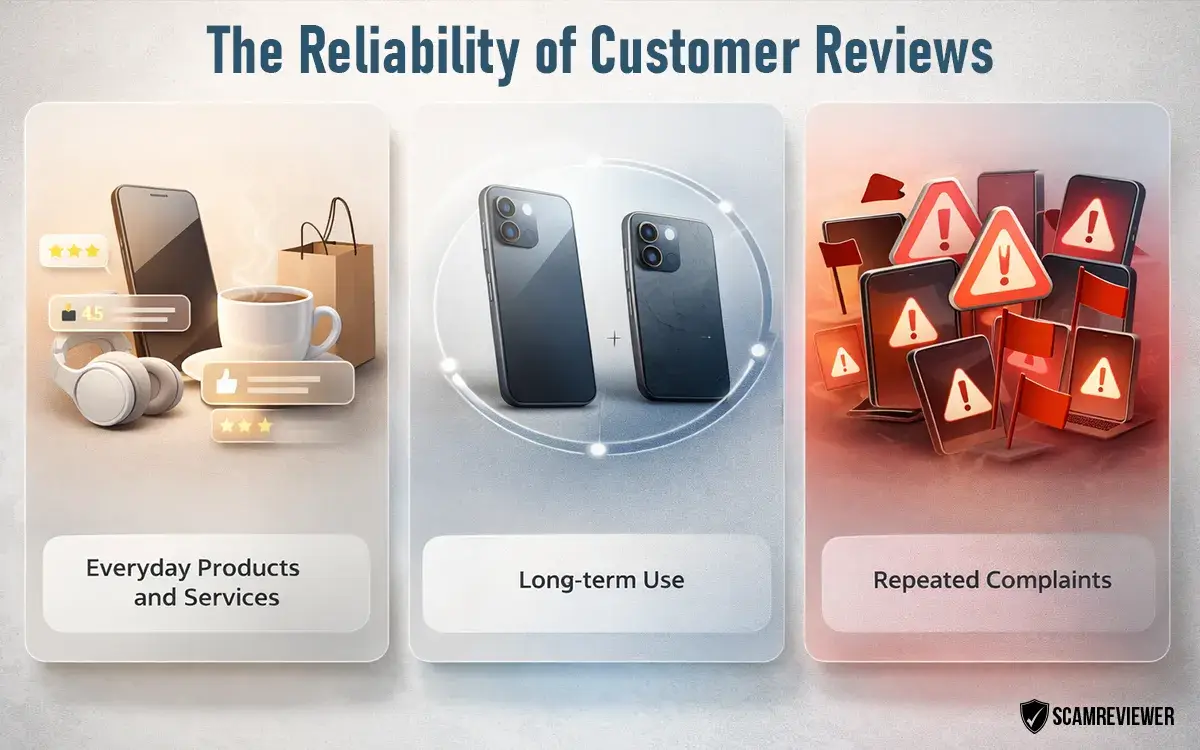
There are situations where customer reviews provide better insight than expert opinions.
-
Everyday Products and Services
For items like household goods, clothing, food services, or apps, customer reviews are often more helpful. They show whether a product actually works in daily use. In these cases, many verified buyer reviews can be more useful than one expert test.
-
Long-Term Use
Experts usually test products briefly. Customers share how things hold up over time. Reviews that mention wear and tear, ongoing costs, or customer support problems help build customer review credibility.
-
Repeated Complaints
One bad review can be ignored. Many similar complaints cannot. When the same issue appears across trending customer reviews , it’s usually real. This helps separate honest feedback from fake customer reviews.
In short, customer reviews are most reliable when you want to understand real experiences over time, not just test results.
When Expert Reviews Matter More
Expert reviews matter more when products are expensive, technical, or related to safety, health, or finances.
The testing process enables you to discover the actual value of your investment when you purchase high-value items such as smartphones and laptops, financial tools and insurance services, and medical devices. The users cannot assess the products because they contain hidden features and dangers that exceed their understanding capacity.
Technical assessment requires expert reviews because the product needs a thorough evaluation. This category includes software and electronics, appliances, and security tools. Professionals use structured methods to measure performance, durability, safety, and efficiency. Customer reviews cannot replace the level of testing that this method provides.
Expert insight becomes necessary for safety-critical areas, which include healthcare, financial services, and data security. The wrong choice in these areas creates major issues that extend beyond simple inconvenience.
Expert reviews deliver better decision support because they highlight all cost elements and technical details, and vital safety aspects.
Risks of Relying on Reviews Alone
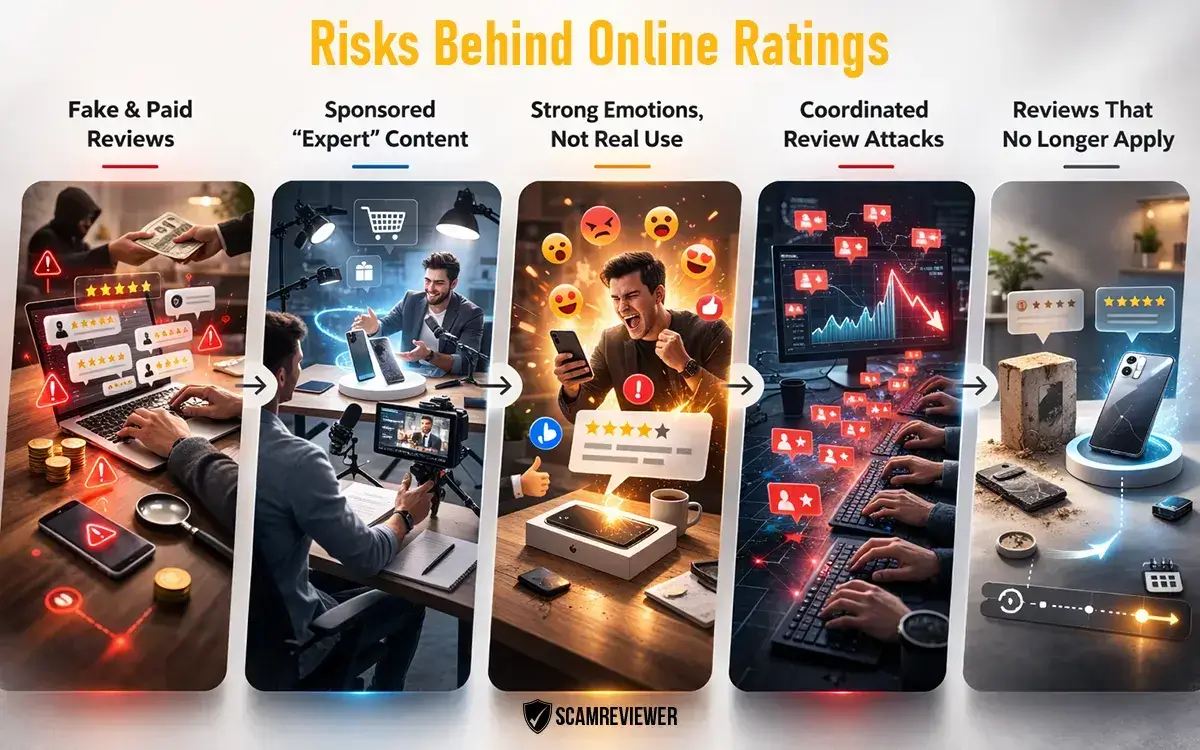
Reviews help, but they shouldn’t be trusted without question. Both customer and expert reviews can be misleading, and that’s where problems begin.
- Fake and Paid Reviews:Some reviews are simply not real. Businesses may buy positive feedback or use fake accounts to raise ratings. This can make weak or risky products look safe.
- Sponsored “Expert” Content:Not all expert opinions are independent. Some reviews are paid promotions disguised as honest advice. If sponsorships aren’t clear, readers may trust biased information.
- Strong Emotions, Not Real Use:People usually write reviews when something goes very right or very wrong. These emotional reactions don’t always represent everyday experience.
- Coordinated Review Attacks:Brands can be targeted by fake negative reviews or boosted with fake praise. These campaigns distort the real quality of a product or service.
- Reviews That No Longer Apply:Many reviews are outdated. Products improve, policies change, and services evolve. Old feedback may no longer reflect reality.
Reviews should point you in the right direction, not decide for you. The safest approach is to cross-check information and look for consistent feedback over time.
How to Evaluate Reviews the Smart Way
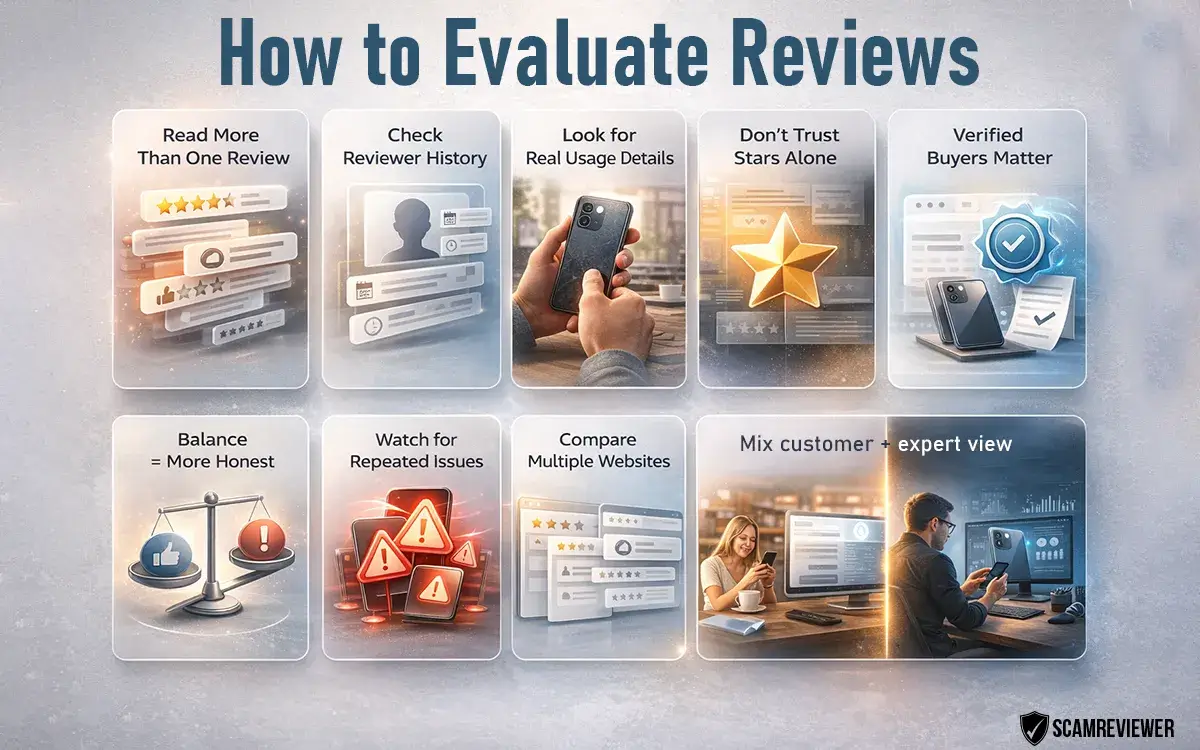
Your reading of reviews should begin with a period of investigation before you reach a final judgment about their content.
Honest reviews become visible through a few quick checks, which enable you to distinguish between authentic reviews and deceptive ones. Reviewers receive their first evaluation through an examination of their background.
The evaluation of products through multiple reviews provides better results than assessing only one review from a single product.
Profiles that display only one extreme review with no further content become suspicious because the review lacks a proper explanation. The review assessment method needs to confirm whether actual product usage comes through in the review content. Verified buyer reviews matter because they confirm the person actually made a purchase. The system establishes authenticity for reviews while it protects against fraudulent and compensated evaluations.
Star ratings alone don’t tell the full story. The perfect score requires an explanation to become useful. The best reviews share both strengths and weaknesses in a calm, realistic way.
Patterns matter more than individual opinions. One negative review may be bad luck, but repeated complaints usually point to a real issue.
Multiple reviews from different websites help to reinforce your understanding. People trust reviews because they see two platforms providing consistent feedback about the same content.
You need to let consumer reviews work together with expert analyses. Customers share real-life experiences, while experts explain technical details and risks. The combination provides you with a trustworthy overview of the situation.
Using Reviews to Avoid Scams
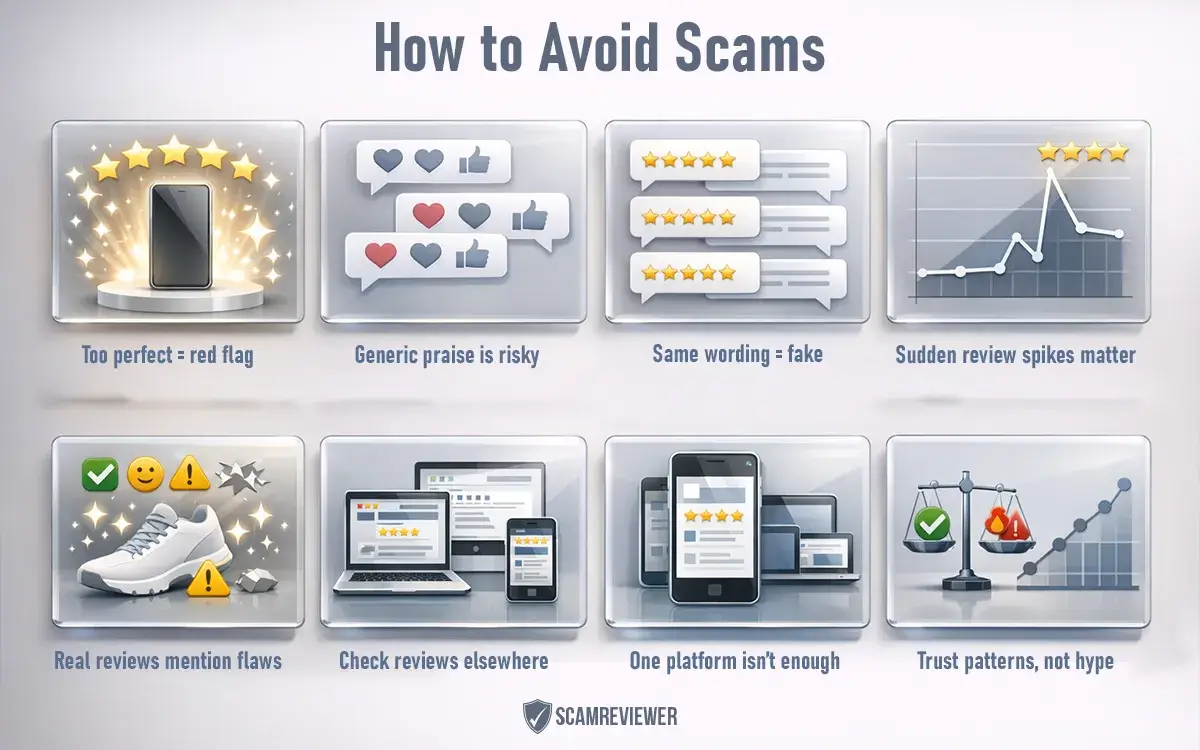
Scammers know that people trust reviews. That’s why fake businesses often look “popular” at first glance. They fill their pages with glowing comments, five-star ratings, and stories that sound just real enough.
But when you slow down and actually read the reviews, patterns start to appear.
Scam reviews usually feel rushed or overly perfect. They focus on how “amazing” everything is but never explain why. There are no real details, no personal experience, and no balance. Just praise.
The problem with fear is that it repeats itself as a continuous cycle. The same source has produced reviews that use identical phrases, match the same tone and observe the same timing. The writing style of actual customers differs from one another.
The time of an event holds important value. The sudden appearance of multiple five-star reviews for a business requires examination because it follows a period of complete silence. Real growth is gradual. Fake growth is fast.
Look for the quiet clues too. Real reviews mention small problems, delays, or things that could be better. Scams usually avoid any negative details at all.
The safest move is to check reviews on more than one website. If a company looks perfect in one place but has warnings everywhere else, trust the warnings.
Reviews won’t stop every scam, but they often leave behind signs. When you learn to read between the lines, you can spot trouble before it reaches you.
The Right Way to Use Reviews
Online decision-making depends heavily on reviews, which have different levels of importance. Customer reviews show real-life experiences, while expert reviews explain performance, safety, and technical details.
Each type of review offers benefits, but each also has limits. The safest approach is not choosing one over the other but knowing when to rely on each. Customer feedback provides insight into how people use products and what problems they encounter over time.
Expert opinions should be used for making important technical decisions that involve high value and risk assessment. People should remain vigilant about potential dangers that exist in their surroundings. The frequency of fake reviews, paid promotions, and review manipulation has reached its highest point in history.
You can avoid expensive errors and possible fraud by reading with attention, searching for recurring themes, and verifying information from various sources.
Asking the right questions leads to smart choices because star ratings do not provide complete information. Critical reading of reviews enables you to protect your financial assets and personal data and your overall safety.
FAQs
Can expert reviews be wrong?
Yes. Experts test products in controlled settings, which may not reflect real-life use. They may also miss long-term problems that only customers notice.
Should I trust a product with only five-star ratings?
Be careful. Products with only perfect reviews often hide negative feedback or use fake reviews. A mix of opinions usually feels more real.
How many reviews should I read before deciding?
There is no fixed number. Focus on the most recent reviews and look for repeated comments or patterns rather than reading every single one.
Do newer products have less reliable reviews?
Yes. Early reviews are often limited and may be written before the product has been used for long. It’s safer to wait for more feedback before making a decision.